In short
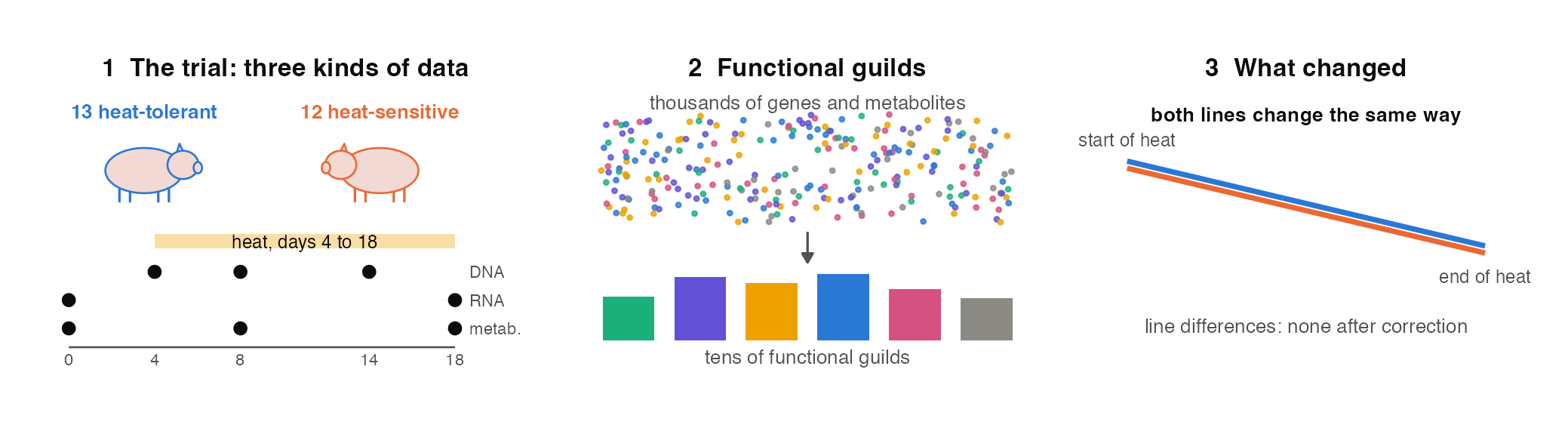
Heat stress lowers milk production, feed intake, and piglet growth in lactating sows. We asked how the gut microbiome responds in sows that are genetically tolerant or sensitive to heat, reading its genes, their activity, and the metabolites it produces. Grouping thousands of these features into a few dozen functional guilds made the data analyzable in 25 animals. The gut's function reorganized steadily through the heat challenge, and it did so the same way in both genetic lines.
The study
- 25 sows from a reference population of 1,381 commercial Landrace × Yorkshire sows: 13 from the top and 12 from the bottom 1% of genomic breeding values for thermotolerance.
- Cyclic heat from day 4 to day 18 of lactation (32 °C by day, 28 °C at night), after four days at 22 °C.
- Three views of the same gut, from feces: gene content (metagenomics, days 4, 8, 14), gene activity (metatranscriptomics, days 0 and 18), and metabolites (metabolomics, days 0, 8, 18).
- Functional guilds: genes were grouped into 22 guilds by function in KEGG, such as fermentation, mucin degradation, or short-chain fatty acid production, and metabolites into 31 chemical classes. Each guild was then tested with mixed models under false-discovery-rate control.
- The framework was checked, not assumed. Guilds captured more temporal signal than random groupings of the same genes (p = 0.012), and standard KEGG-module profiling gave the same result.
What we found
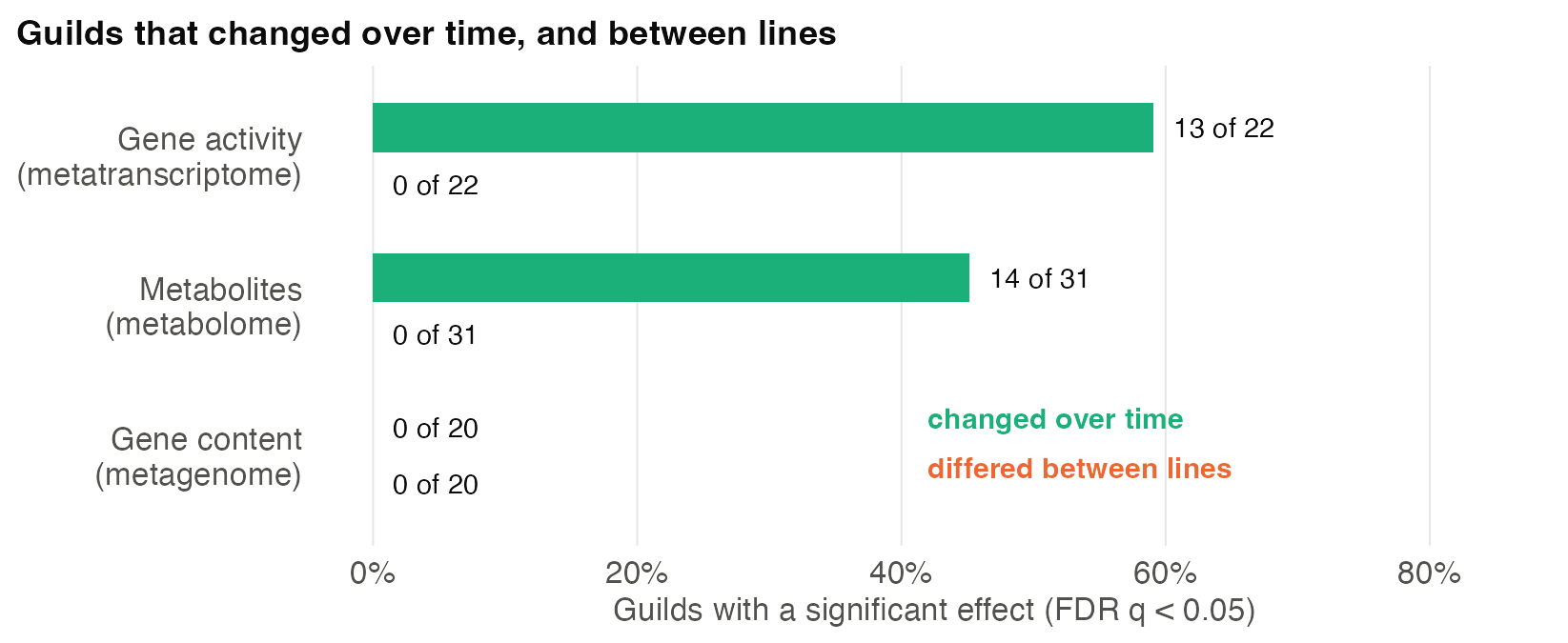
Gut function changed over the heat challenge. Gene activity changed over time in 13 of 22 guilds and metabolites in 14 of 31. The strongest metabolite changes were declines in sphingolipids (q = 2.3 × 10⁻⁷), flavonoids, and tannins. The fall in plant-derived compounds fits the lower feed intake under heat. Sphingolipids, some of which support the gut barrier, had not returned to baseline by day 18. Gene content changed little over the sampled window.
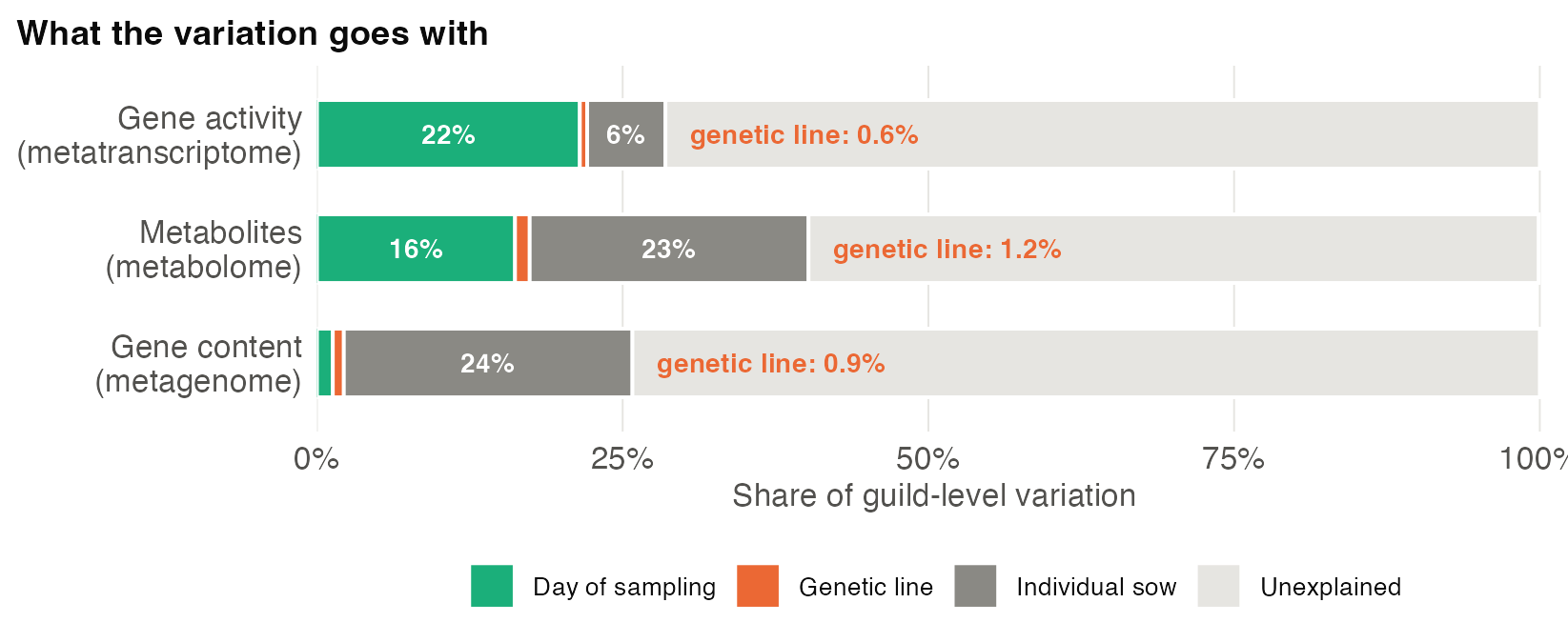
The two lines responded alike. No guild differed between the lines, and no line-by-time interaction survived correction, in any of the three layers. The communities did not separate by line at any time point (PERMANOVA p ≥ 0.21). Genetic line accounted for at most 1.2% of guild-level variation, against 16 to 22% for time.
Genotype acts on function indirectly. Breeding values for thermotolerance capture how a sow's body copes with heat, through feed intake, heat production, and behavior, and these differences, together with the heat itself, are the likely drivers of change in the gut. The companion study of the same sows found that the lines did diverge in which microbes they carried. Different communities reaching the same functional output is known as functional redundancy. Selecting for better thermal physiology would therefore reshape the microbiome as a downstream consequence rather than as a separate target.
One pattern is a hypothesis, not a finding. By day 14, tolerant sows tended to carry more genes for fermentation, methane production, and short-chain fatty acid production, while their gene activity declined in more guilds than in sensitive sows. If real, tolerant sows might sustain gut function through a larger community rather than more activity per cell. None of these differences survived statistical correction.
What comes next
- Larger cohorts. With 25 sows, power for line differences is limited; larger studies, with more accurate breeding values, can confirm the direction of cause and effect.
- Testing the capacity–activity idea. Whether tolerant sows maintain function through a larger microbial community is the main hypothesis for an adequately powered follow-up.
- Aligned sampling. Sampling genes, gene activity, and metabolites on the same days would allow point-to-point comparisons across the three layers.
- Targeted chemistry. Targeted assays for sphingolipids and short-chain fatty acids would measure the most responsive compounds more precisely.
- Taxa and function together. Guilds trade away taxonomic detail; combining them with taxonomic profiles would show functional redundancy directly.