In short
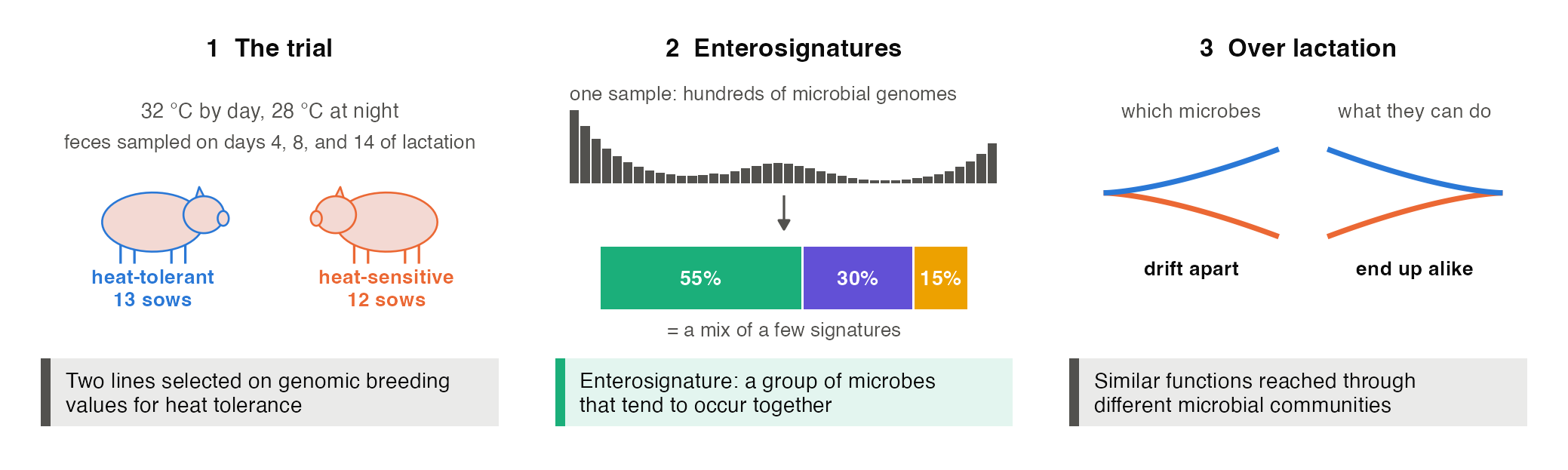
Heat stress costs pig producers through lower feed intake, milk, and litter growth, and the gut microbiota is one of the systems it disrupts. We followed the gut communities of 25 lactating sows from two lines selected for heat tolerance or heat sensitivity, kept under a daily heat cycle. Instead of tracking hundreds of microbes one by one, we described each sample as a mix of a few enterosignatures, groups of microbes that tend to occur together. Over two weeks the two lines moved toward the same functional profile, but by different routes: tolerant sows toward diverse, balanced communities, sensitive sows less so.
The study
- 25 multiparous sows (Duroc × Landrace × Yorkshire): 13 from the heat-tolerant and 12 from the heat-sensitive end of the distribution of genomic breeding values for heat resilience.
- A daily heat cycle from farrowing to weaning: 32 °C by day, 28 °C at night.
- Fecal metagenomes on days 4, 8, and 14 of lactation (74 samples), assembled into 835 metagenome-assembled genomes (MAGs) and annotated for gene function (KEGG orthologs).
- Enterosignatures found by non-negative matrix factorization: 8 taxonomic signatures (T-ES) from the MAGs and 5 functional signatures (F-ES) from the genes. Each sample is described by how much of each signature it contains, and labeled by the one that leads.
What we found
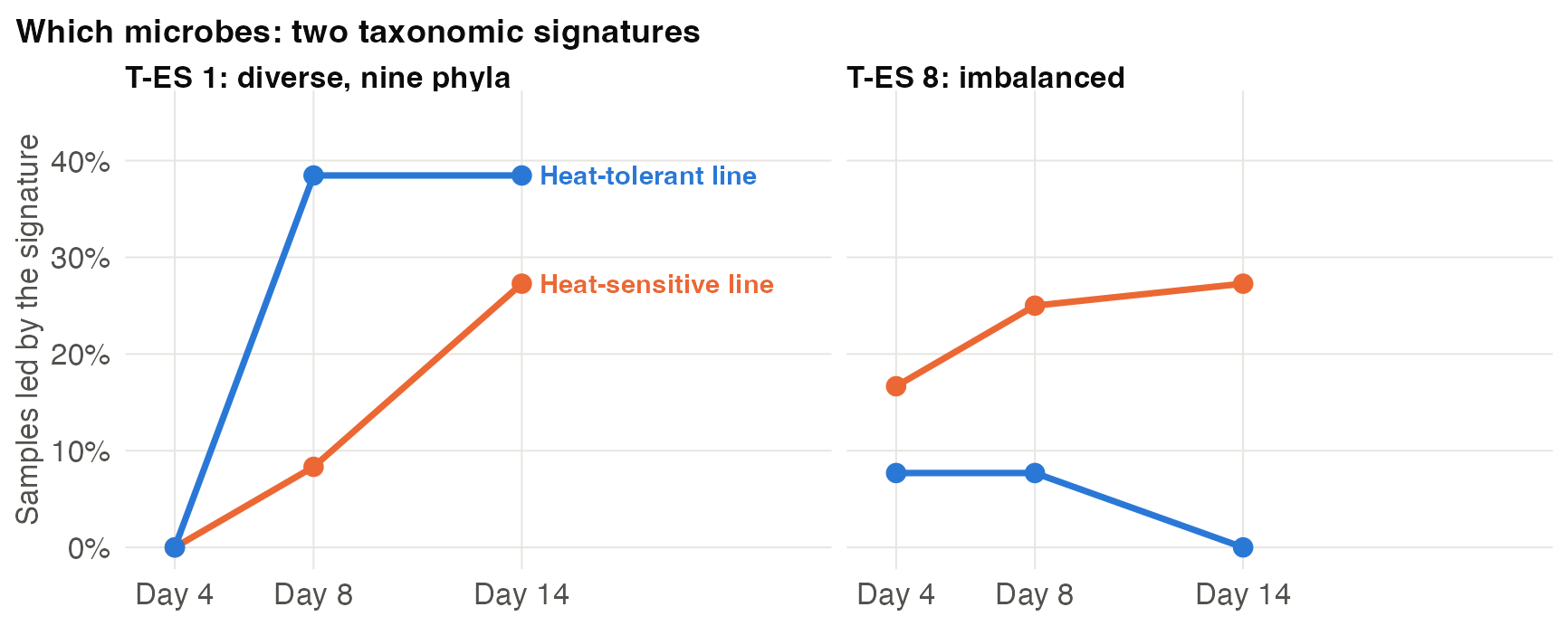
Time changed the communities more than genetic line. The clearest change was the rise of T-ES 1, a phylogenetically broad signature spanning nine phyla, from Bacteroidota to Fibrobacterota and Spirochaetota. It led none of the day-4 samples and 38% of tolerant and 27% of sensitive samples by day 14 (time effect p = 5 × 10⁻⁴).
The lines took different taxonomic routes. Tolerant sows moved progressively toward phylogenetically diverse, balanced communities. Sensitive sows moved toward imbalanced states: enrichment of taxa that can act as opportunistic pathogens (T-ES 2, with Corynebacterium, Enterococcus faecium, and Escherichia coli), or dominance by a single taxon (T-ES 3, in which one Lactobacillus amylovorus genome made up 88% of the signature). T-ES 8 led a quarter of sensitive samples by day 8 and day 14 and showed the largest difference between the lines late in lactation (Cohen's d = 0.96), although the confidence interval was wide and the test was not significant (p = 0.76). The distance between the lines in taxonomic space grew from day 4 to day 14, a trend that fell short of significance (p = 0.10).
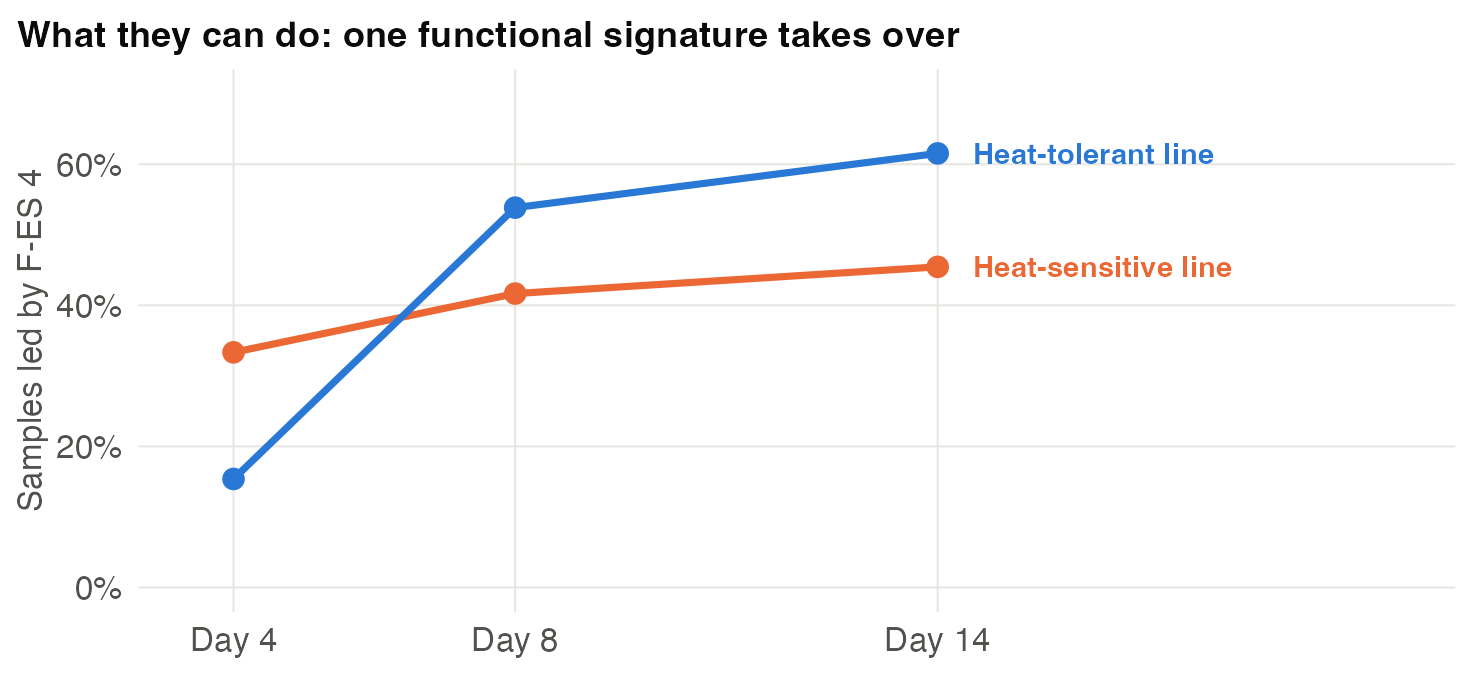
Functionally, the two lines converged. One functional signature, F-ES 4, rich in protein secretion and regulatory genes, became the most common in both lines, leading 62% of tolerant and 45% of sensitive samples by day 14. Several different taxonomic signatures mapped onto it. Different microbial communities can therefore carry out much the same functions, a property known as functional redundancy, and the two lines never differed measurably in functional space.
The route may matter more than the endpoint. Imbalanced states found only in sensitive sows, such as the functional signature F-ES 3 that accompanies the Lactobacillus-dominated state, suggest that enterosignatures could help flag heat-susceptible animals early, if the pattern holds in larger studies.
What comes next
- Controls and baselines. Sows kept at a comfortable temperature, and samples taken before the heat begins, would tie the changes to heat itself.
- Larger cohorts. With 25 sows, most differences between the lines are effect sizes rather than significant tests; confirming them needs more animals.
- Repeated heat cycles. Following sows through several cycles would show whether communities return to the same states or drift toward new ones.
- Beyond feces. Sampling the small intestine and the gut lining would show how each region responds.
- Genetics and causation. The imbalanced signatures seen only in sensitive sows can be tested for heritability as early indicators of heat susceptibility, and microbiota transfer experiments could show whether these communities shape tolerance or only reflect it.